Blog

  • Digital Art History

    Digital Art History

    At Bucknell University as part of a Library and Information Technology Mellon Summer Curricular grant, Art History Professor Janice Mann worked with me to redesign her ARTH 373 “The West Encounters the Rest.” The class examined what happens to the visual arts when European cultures encounter those in other parts of the globe. Moving chronologically from the 15th to the early 20th century, ARTH373 explored how the visual arts develop in response to encounters between cultures with different cultural identities and artistic traditions. The redesign focused on facilitating collaborative learning and co-inquiry through activity-centered digital projects.

    Students in the Samek Gallery creating Smart History style videos with their smart phones.

    Students collaborated on a range of digital projects over the course of the semester. Beyond regularly contributing to a course blog, students developed concepts for curating works of art from the Samek. They created two SmartHistory-style videos: the first assignment was based on works housed in the Samek and the second assignment was based on works housed in the Metropolitan Museum of Art. They researched, wrote, and collaboratively edited a Wikipedia entry on Chinoiserie. The Wikipedia assignment resulted in heated and thoughtful conversations about description vs. opinion and the cultural readings and ramifications of word choice.

    In producing the culminating project for the semester, students worked with objects housed in the local Packwood House Museum. Students identified objects that aligned with the focus of the course and created a digital exhibition: Asian Objects at the Packwood House. The project was created in Adobe Spark. There are formatting limitations to Spark, but two of the deciding factors in using the platform was that it was free and HTML5 compatible, which means that it readily adapts to smart phones and devices. This was crucial for us in deciding on the platform because we wanted people visiting the museum to be able to use the project as a virtual tour guide.

    After the course, three of the students applied to do summer research with Professor Mann, which resulted in the Packwood House Museum Digital Collections. One of the students, Ariel Senackerib is now pursuing a masters program at Sotherby’s.

    Sites:

  • Bot or Not: Digital Essay

    Bot or Not: Digital Essay

    The documents for this digital essay assignment were created for a first year composition course, ENGL101.05 “Bot or Not: Technology, Identity, Autonomy.” The course was taught in the fall of 2015.

    The digital essay assignment was based on Donna Haraway’s “Cyborg Manifesto” in which she argues that we are all cyborgs. After spending a week reading and discussing Haraway’s text, the students did an in class-writing exercise where they articulated arguments for seeing themselves as cyborgs. This writing was then revised, workshopped through peer review, and became the basis of the script for their digital essay.

    Documents:

    Student Example and Response:

    “When my professor first assigned a digital essay, I was apprehensive: I had never done anything like it before, I had no experience with Final Cut Pro, and I can’t stand listening to recordings of my voice. Then I started working on my essay. Once I had a script I liked, I had fun recording in the audio booth and editing in Final Cut. I ended up being really happy with my final product and I’m glad I was exposed to the resources Bucknell has for developing multi-modal work!” –Elizabeth Montesano, Engineering


    Creative Commons License
    The assignment, assessment, and peer review sheets on this page are licensed under a Creative Commons Attribution-NonCommercial-ShareAlike 4.0 International License.

  • Digital Scholarship at Bucknell: It’s About Building Relationships

    Digital Scholarship at Bucknell: It’s About Building Relationships

    Presentation with Matthew Gardzina at DLF: Liberal Arts College Preconference, Vancouver, BC, October 2015.
    A video recording of the session can be accessed here.
    Abstract: Charged with creating a digital humanities initiative that was innovative, intentional, and collaborative, Library and Information Technology realized that we required an inclusive approach that opened up digital scholarship to all divisions at Bucknell while emphasizing the liberal arts’ commitment to student engagement. Short answer: it’s about building relationships. Ten years ago Bucknell’s Digital Initiatives group, Instructional Technology (ITEC), and Research Services were responsive service providers, but did little to drive innovation. Today, a reimagined ITEC, comprised of instructional technologists, GIS and multi-media specialists, postdocs, and digital scholarship coordinators leads digital scholarship efforts on campus by moving from transactional to transformational interactions in order to foster lasting partnerships. As an instructional technology group, we have found that our first interactions with faculty are often helping to develop an assignment for a course. Even in these early conversations, we consult on pedagogical design when discussing timelines, training, digital literacies, privacy, and assessment of multi-modal projects. Moving forward, the relationships we build with faculty and students often involve collaborations on scholarship, multi-semester projects, summer research grants (for students to work with faculty and members of ITEC), making connections across disciplines and divisions, and faculty course redesigns, all of which impact students and their engagement in coursework and scholarly research. While there are challenges for building digital scholarship efforts at a LACs, ITEC maintains a unique position as a hybrid group–with strengths in academics and technology–within a merged L&IT division. This allows us to draw on the expertise of our research librarians, web programmers, and systems integration team. Building a cohort of digital practitioners hasn’t been all unicorns and rainbows, there have been learning curves, failures, and workflow challenges arising out of our own success. We’ll be sure to cover it all in twenty minutes and include a picture of a puppy.//
  • #BUDSC15

    #BUDSC15

    The Bucknell Digital Scholarship Conference, #BUDSC15, “Collaborating Digitally: Engaging Students in Public Scholarship” took place on Nov 6-8, 2015. It was my second year co-chairing the conference. This year, I had the invaluable help of Carrie Johnston (Postdoc in Digital Scholarship) and Brianna Derr (Instructional Technologist Specializing in Video). The conference was covered by Bucknell University’s Communications Department and the Bucknellian.

  • Digital Scholarship at Bucknell

    Digital Scholarship at Bucknell

    This post originally appeared as part of the Member Update series for the Digital Library Federation on February 23, 2015.

    This Member Update was provided by Param Bedi, Vice President for Library & Information Technology, Matt Gardzina, Director for Instructional Technology, and Emily Sherwood, CLIR Postdoc for Digital Scholarship, Bucknell University.
    At Bucknell University “Digital Scholarship” is defined as any scholarly activity that makes extensive use of one or more of the new possibilities for teaching, learning and research opened up by the unique affordances of digital media. These include, but are not limited to, new forms of collaboration, new forms of publication, and new methods for visualizing and analyzing data. We believe that applying these digital tools and methodologies broadens and deepens the learning experience for faculty and students alike, facilitating connections between research, coursework, and scholarly engagement that extends beyond Bucknell.Bucknell DLF Contribute - graphicOur combined Library and Information Technology division has been central in the intentional advancement of digital scholarship across campus. While the library has anticipated the needs of the campus community by building the Digital Scholarship Center within the library, we have also acknowledged that infrastructure is nothing without the right people and partnerships. Over the last few years, we have brought together a dynamic team of practitioners including research librarians, instructional technologists, digital scholarship coordinators, GIS specialists, multimedia specialists, and a CLIR/DLF postdoc. Although we have made great progress in building a strong digital scholarship program and partnerships across campus, we quickly realized that the most dynamic and innovative ideas are developed in the spirit of collaboration, whether internally or as part of a broader discourse. To that end, in November 2014, Library and IT at Bucknell hosted our first annual Digital Scholarship Conference, “Collaborating Digitally: Engaging Students in Faculty Research.”https://twitter.com/windloochie/status/533998005062352896
    Funded by The Andrew W. Mellon Foundation, as part of a multi-year grant, #BUDSC14 brought together over 150 practitioners to discuss challenges, share working models, reflect on projects, and inspire new avenues for actively including students in scholarly pursuits, whether inside or outside of the classroom. Over the course of three days, faculty, administrators, instructional technologists, librarians, archivists, and graduate and undergraduate students from 47 institutions began a generative discourse that will continue to impact their scholarly, academic, and institutional practices moving forward.Bucknell’s commitment to student engagement and the expansion of available learning environments for our students was evident in the conference theme. While other conferences emphasize large digital humanities projects, specific tools, or may touch on pedagogy, our focus remains student-centered. Repeatedly, back channel Twitter discussions praised the student presenters from various institutions. The broad range of skills students acquired, the professionalism with which they spoke about their subjects, and their enthusiasm for their research affirmed our beliefs that students are highly capable of and will greatly benefit from this type of work.Bucknell Digital Scholarship ConferenceAs part of our ongoing outreach, we look forward to furthering the conversations begun at #BUDSC14 at our second annual Digital Scholarship Conference on November 6-8, 2015. The CFP will be posted later this spring. Until then, for more on the conference–including, abstracts and keynote videos from Chris Long and Zeynep Tufekci – please see our website.

  • RHS 2014 Graduation Speech

    RHS 2014 Graduation Speech

    RHS2014On Tuesday, June 10, 2014, there was a shooting at Reynolds High School in Troutdale, Oregon. Emilio Hoffman, a freshman, was killed when he came upon the shooter in the locker room. PE teacher Todd Rispler was grazed by a bullet when he went to alert the rest of the school of the presence of the gunman. The gunman, also a student at Reynolds, killed himself after a standoff with the police. During the tragic events of the day and in the days after, the faculty and students were exemplary in their response. Reynolds is my alma mater. While I haven’t lived in Troutdale since I was 18, the impact of the shooting was immediate and deeply felt. On June 12, I was honored–and a bit overwhelmed–to give the commencement address at Reynold’s graduation ceremony. It was a challenging speech to write in light of the events of that week. But I was proud of and humbled by the Reynolds community, faculty, and students. And my gratitude goes out to Teresa Osborne and Emily Moore-Coon who invited me to speak. You can watch my address on the Oregon Live website.

  • Mural.ly in the Hybrid Classroom

    Mural.ly in the Hybrid Classroom

    While working on hybrid course this semester, Lisa Brundage and I experimented with forums and blog posts in order to get students to connect and discuss in an online space. Both the blog and forum worked in a limited capacity, but the students never fully engaged with each other, they simply fulfilled the assignments. When we turned to our class project–a digital companion to Margaret Atwood’s The Year of the Flood–I suggested that we try a virtual white board tool, Mural.ly, for planning the project. This format is different in that it removes much of the hierarchical structure found in blog posts/comments or forums. The mural allows students to add shapes, text, draw lines, overlap ideas, and add post-it notes. It also has a standard commenting feature, but one that can be attached to any element on the mural. In this way, even the comment threads are spatially located within a broader discourse or subject. Within 24 hours of setting up the mural, students were posting and responding to each other in an open, engaged, and frequent fashion that we had tried–and failed–to foster all semester. The video below shows a rough estimate of the development of the mural in matter of weeks. The experiment was so successful that we abandoned the class forum and started another mural for class readings and general discussion. It, too, has continued to prove productive and prolific. This is just one example of the need for experimentation when it comes to online spaces. When we think about how and why online learning should inform our pedagogical practices, I think it is useful to consider the importance of disruption in the educational process. Disruption is the willingness to experiment, fail, and try again. Standard teaching methods, like lectures, do not always allow for this. It wasn’t that our students weren’t willing to engage each other outside of face-to-face class, it was that we hadn’t yet found the space where they felt comfortable doing so. Mural.ly might not work for other classes, but it is worth considering that sometimes our students need online spaces that match the messiness of classroom interaction where a call and response–that matches the forum or blog/comment structure–may not be the most effective way for them to draw connections, engage with each other, and learn.

    http://www.youtube.com/watch?v=FcJxNMdK7dY

  • How to Create a Timeline

    How to Create a Timeline

    This post originally appeared as part of the Monthly Social Justice Topic Series on Stop-And-Frisk from JustPublics@365.

    Throughout this topic series, we will introduce knowledge streams and digital tools that can help you present information in engaging and meaningful ways. The Timeline JS tool used to create the Stop-and-Frisk timeline is one of these tools.

    Timelines allow you to craft a narrative for your audience, gather a wide range of information, and provide a platform that is clean, clear, and interactive. Whether designing a class project, curating data and resources for an academic article, or presenting a history of your community group, timelines naturally combine the visual and textual in an easy to follow format.

    While digital tools change at a rapid rate, a current favorite timeline of mine is Timeline JS. Developed by Zach Wise as part of Northwestern University’s Knight Lab, the tool is simple to use and produces visually appealing, interactive timelines that are easily embedded on a website.

    To get started, download the Google spreadsheet template. You can then pull in media directly from Wikipedia, Soundcloud, YouTube, GoogleMaps, Twitter, Flicker, and more. There are clear step-by-step instructions on on the Timeline JS website, including a video tutorial and an excellent Help section. We’ve also made some screencasts to get you started. The first walks you through the basics of creating a timeline, the second highlights some of the options available.

    Timeline Basics

    http://www.youtube.com/watch?v=DPJyolBkwQU

    Working in the Template

    http://www.youtube.com/watch?v=OEqfqqPlmuA


    Top 3 Timeline Tips

    1. Create a clear narrative. The strongest timelines are those that tell a clear narrative. Though presented in a visual form, timelines are much like any research paper or story: they work best when they have a good organizational structure and the order of the argument makes sense.

    2. Incorporate a range of media. Images are only one way to ground your text. Charts, maps, documents, links to other sources, video, and infographics can give your project a more robust feel and provide your reader with further avenues to explore on the topic.

    3. Cross-promote content. Timelines let you curate a broad range of information. If there are academics, journalists, activists, or community groups working on the subject, be sure to include links to their websites, tweets that are relevant to the topic, and events or research that they’ve done. Not only will this broaden the readership of your timeline, but it will direct people to important work being done in the field.

    In the comments, please feel free to share links to your own timeline projects.

  • Stop-and-Frisk Timeline

    Stop-and-Frisk Timeline

    This post originally appeared as part of the Monthly Social Justice Topic Series on Stop-And-Frisk from JustPublics@365.

    This timeline illustrates some of the major moments of, responses to, and influences on Stop and Frisk dating back to Terry vs. Ohio, the 1968 Supreme Court decision to the present Federal District Court ruling on Floyd v. New York City. Collected here are important documents, reports, and films, created by the state, activists, research and community institutions. In the comments, we welcome your suggestions for other entries to add to the timeline.

    [iframe http://embed.verite.co/timeline/?source=0Aibm3bgtn4WndG9LWklURS1LQjJvU3RBRE9pY2RIa2c&font=PTSerif-PTSans&maptype=ROADMAP&lang=en&hash_bookmark=true&height=750 760 750]

  • Editing Shakespeare for the Web

    Editing Shakespeare for the Web

    This post originally appeared in Upstart: Essays and Conversations About Early Modern English Studies, on March 29, 2013.

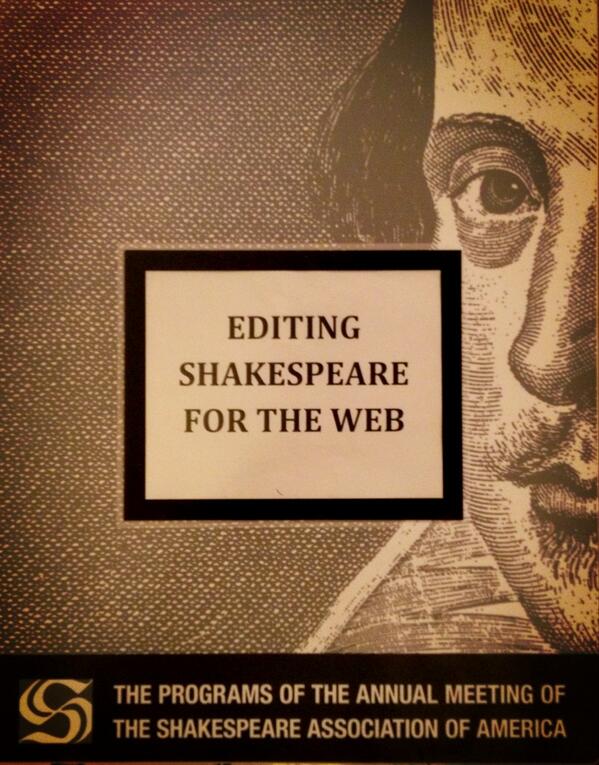
    BGdVMryCQAABPwOEarly Thursday morning—okay not that early, but the coffee hadn’t quite permeated my system, yet—I sat in as an auditor on Jeremy Ehrlich’s workshop on “Editing Shakespeare for the Web.” Happily for me, there were several familiar faces as participants and auditors; overall, it was a good turnout for the first session of the conference. Ehrlich began by explaining that the participants had all submitted rationale for and samples of editorial projects. As members of the workshop briefly presented their proposals, there arose repetition in questions, dilemmas, and potential sights of convergence in the aims.

    For anyone acquainted with discussions of digital humanities projects, instructional technology, or the development of digital tools, the broad themes were all too familiar: Who is your audience? How do you create an interface that doesn’t scare away readers, but also encourages deeper involvement? How do you cater to both the superficial and inquisitive reader? How do structure your data in an intelligent way so that it can produce multiple layers of information from the data set? How do you document your work so that it can be reproduced going forward? How do you avoid technologies that are already almost obsolete? How do you make a curated scholarly repository that is also aesthetically pleasing and easy to navigate? Similarly, how do we teach scholars—who we need to do the research and who we understand as one of our primary audiences—information architecture and tagging? When do we acknowledge that there is value and tremendous labor in tagging, coding, and transforming the research into a viable product? Can we finally admit that visualizations are vital to our work as scholars and an integral part in how we engage online? Where do we as editors reach for the theoretical support for the work that we’re doing? How do we balance the problem of not wanting to re-learn how to read every time we encounter a new online edition or tool with the reality that our approaches are different? And when can we move away from insisting that online content must easily be exported to a printable form?

    The last question might be mine. I understand the need to share a text that has been annotated and framed in a specific way, but in limiting online editions to ones that can be readily transferred to print, I think you miss out on the variety of data, forms, and malleability that we gain in moving from the printed page to the digital. In this light, the exciting take-aways for me on this panel were the discussions of how various projects might work together—Map of Early Modern London and Internet Shakespeare Editions—to form robust and visually engaging texts; and the collaborative possibilities for scholars, students, and theatrical practitioners with tools such as Open Source Shakespeare‘sMarginalia prototype. While the workshop may not have answered all of the questions posed and while we may come to these projects with various knowledge bases and outcomes in mind, the progress being made and the possibilities that lie ahead provide promise for the future of editing.