Blog

  • On Gratitude, Impact, and Embracing the Plot Twist

    On Gratitude, Impact, and Embracing the Plot Twist

    This fall, I was invited to be the keynote speaker at the annual Thomas W. Smith Academic Fellowship Awards Ceremony for the CUNY Baccalaureate Program. I was honored to celebrate the new batch of Smith Fellows, a creative, tenacious, and inspiring bunch of students who epitomize the promise of CUNY. It was also a unique opportunity to say thank you to Mr. Thomas W. Smith, the benefactor of the fellowship, who attends the ceremony every year. At 97 years old, there are many remarkable things to say about Mr. Smith. But I think it’s important to highlight that since 1994, he has helped nearly 1,200 students complete their bachelor’s degree at CUNY. The impact of that kind of generosity and support cannot be measured.

    With many thanks to Tracy Mejia Urena (Scholarship & Events Specialist, CUNY BA) for the invitation. And gratitude to Joshua Brumberg (President, The Graduate Center, CUNY), Brian A. Peterson (Interim Senior Vice President and Dean, The Graduate Center) and Jody Clark Vaisman (Academic Director, CUNY BA) for the warm welcome. Returning to the Graduate Center and CUNY always feels like coming home.

    Below are my remarks from that evening, edited slightly for ease of reading. I want to emphasize that my story is not unique. It is a very typical CUNY story. This one just happens to be mine.
    October 14, 2025, Thomas W. Smith Academic Fellowship Awards Ceremony for the CUNY Baccalaureate Program.

    In the fall of 2001, I went back to school to finish my bachelor’s degree. I had a lot of credits, but no degree. I remember being unsure about committing two years to finishing my bachelor’s. I remember my mother telling me that the two years would pass anyway, but if I went back to school then at the end of the two years, I’d have my degree. It was very solid mom advice. I was drawn to the CUNY BA program because I wanted to design my own degree, to take full advantage of my previous college coursework, and to have more control over my education. My areas of concentration were dramatic literature, theatre, and playwrighting. I thought I’d finish my bachelor’s and do an MFA in Acting. Spoiler Alert: That didn’t happen.

    At the time, I was working full-time at night and on the weekends so that I could go to school full-time during the day. It was hard. I didn’t get a lot of sleep. Looking back, I have no idea how I did it. I remember walking home from the subway at 8:30am after an overnight shift and everyone else would be headed to work. I remember how exhausted I felt: that bone-tired feeling. More than once, I found myself crying on that walk thinking about the hour nap I might be able to fit in before going to class. It was hard living in New York, working, paying my tuition as I went. But it was worth it, too. When I heard about the Thomas W. Smith Academic Fellowship, I was excited. Not just because of the honor—and it is an honor—but because the funding would make a huge difference in my life. It did make a huge difference. Because I knew if I got sick or had to take a day off to finish a paper, it would be ok. The Smith Fellowship gave me room to breathe and that was no small thing.

    I don’t talk a lot about how hard that time was for me because in retrospect, I’m really proud of it and the hard was worth it. I have a bachelors, a masters, an MPhil, a PhD—yes, way too many degrees—but I’ve always been the most proud of finishing my bachelor’s degree. It wasn’t easy. I was nervous about going back to school after years away. I wasn’t sure I’d be good at it. I was always worried about balancing work and school, but I needed work to pay for school. I was worried that the time and the stress and the money wouldn’t be worth it. But it was. And the Smith Fellowship offered support at a time when I really needed it. For that I’m grateful. I’m guessing many of you here today can relate.

    It’s not often that we get the chance to thank someone twenty-plus years after the fact. To share a bit about how their generosity has impacted our lives. To say thank you in person. I’m thrilled to be here today to do just that. Thank you, Mr. Smith for believing not just in me, but in all of the CUNY BA students who have been awarded the Thomas W. Smith Academic Fellowship over the years. I think about the impact the fellowship had on my life and then I multiply that by all of the lives here today and those who have come before us. Multiply that by our families and friends and communities that have benefited and will benefit from our growth and education. The impact that Mr. Smith has had and continues to have is awe inspiring. So, thank you, Mr. Smith, for the ripples of inspiration and support that you have sent out into the world through this fellowship so that we may continue to impact others.

    I’m supposed to tell you what I’ve been up to since I graduated way back in 2003. I think a lot of it is covered in my bio. The short version is: I got a bunch of degrees in things I thought I wanted to do. But it turns out that sometimes as you go along, if you listen closely and think about the kinds of work you like to do, if you are open to the different possibilities that pop-up, if instead of focusing on what your degree says and more about how you like to solve problems, or listen, or bring people together, you sometimes end up somewhere totally unexpected and wonderful. And that’s ok.

    I think one of the things I learned as a CUNY BA student—beyond creativity and problem solving and tenacity in the face of navigating the complex and often frustrating system that is CUNY—is that there are connections and knowledge in the spaces in between and that they can tell us a lot about where we want to go. That is the heart of interdisciplinary study: that new knowledge at the intersections. That is what makes this program so unique.

    After I completed my masters degree, I was accepted to the PhD program in English here at the Graduate Center. Much like in undergrad, I worked throughout my PhD in investment banking, in publishing, in higher ed. The last few years of the program, I was an Instructional Technology Fellow at Macaulay Honors College. There I worked with faculty across disciplines to incorporate digital projects in the classroom. I loved helping the faculty and students learn technology. It was at Macaulay that I discovered I liked working with others to solve problems, that I enjoyed bringing people together from different disciplines and backgrounds to tackle big ideas.

    So rather than becoming an actor—my plan when I started the CUNY BA program—or a literature professor—my plan when I started my PhD—I started working in libraries, where I spent a decade helping students and faculty enhance their education and research through technology. I started as a postdoc, then became an assistant director, then a director of a department, where I also got to open a hub for augmented and virtual reality.

    Along the way, I had a lot of support and people who believed in me, even when my background and path didn’t look like everyone thought it should. What has kept me moving forward is always staying curious about the next thing. Whether that was the next new technology or helping my colleagues grow in their careers.

    This past year I started a new position as University Librarian at Rochester Institute of Technology. That basically means I run the library. It’s a big job. I’m responsible for almost 50 people, which often makes me nervous. In those moments, I try to remember the opportunities I have been given. The mentorship I’ve had throughout my academic and professional career. The people who have advocated for me and believed in me. It brings me joy and a bit of hope to be able to offer the same support to others.

    Working at RIT feels like a full circle moment. When I started the CUNY BA program, I worked doing computer things at an investment bank to put myself through school so I could study theater and literature. Technology and the arts. Now I run a library at a tech school that is known for celebrating the intersections of technology and the arts. I couldn’t have imagined this job or this school when I was where you are now, but it is exactly where I want to be, where I should be.

    All of this is to say, pay attention to what you love, what type of work you’re drawn to, what challenges you enjoy, what problems keep you up at night, even when things are hard, maybe especially when they’re hard. Because it is those things that often help us find a way forward. The destination may not be what we expect, but it might be better. Thank you.
  • Ninth Triennial Rulemaking Proceeding, DMCA

    Ninth Triennial Rulemaking Proceeding, DMCA

    In spring of 2024, I testified before the Copyright Office for Library of Congress in support of a petition to expand exemptions for Text and Data Mining (Class 3a: Motion Pictures) as part of ninth triennial rulemaking proceeding under the Digital Millennium Copyright Act (DMCA). My testimony focused on research that Digital Scholarship at River Campus Libraries had been working on with Professor Joel Burges (University of Rochester) and Professor Allison Cooper (Bowdoin College) as part of a Mellon Foundation Public Knowledge Grant on the history of the close-up in film and television (https://www.library.rochester.edu/about/news/close-close-ups).

    In October of 2024, the Library of Congress, following recommendations from the Copyright Office, released its ruling on the renewal and expansion of exemptions to prohibitions on circumvention of technological protection measures. For the purpose of our research, the following outcomes (highlighted in this post by the Author’s Alliance) were important:

    • The exemption now allows access to a corpora for research and teaching without requirements that the research be a collaboration. This means that if I create a corpora and you, as a researcher, want to verify my data after the fact, continue my research, or as new questions of your own, you can do that.
    • The recommendations clarified that “close-viewing” of media is allowed if it furthers the research and is not for the work’s expressive value. In other words, researchers can watch copyrighted materials and mark or annotate them in order to generate data to further their research. This is an important clarification and crucial for our research which relies on close viewing in order to generate data on representation.

    Working with Professor Burges, Professor Cooper, the Authors Alliance, and the Samuelson Law, Technology & Public Policy Clinic at UC Berkeley on this petition and the testimony was both an impactful experience. Too often, we don’t get to see significant change as a byproduct of our research, but effectively advocating for the needs of researchers and having that result in concrete recommendations and a ruling from the Library of Congress is exactly that. I am grateful to my colleagues and the folks at the Authors Alliance, Samuelson Law Clinic, and the Mellon Foundation for the opportunity.

    Image Credit: Copyright Office. Library of Congress. Washington D.C, ca. 1920. Photograph. https://www.loc.gov/item/2005694708/.

  • Gwennie Award, DEI Initiatives

    Gwennie Award, DEI Initiatives

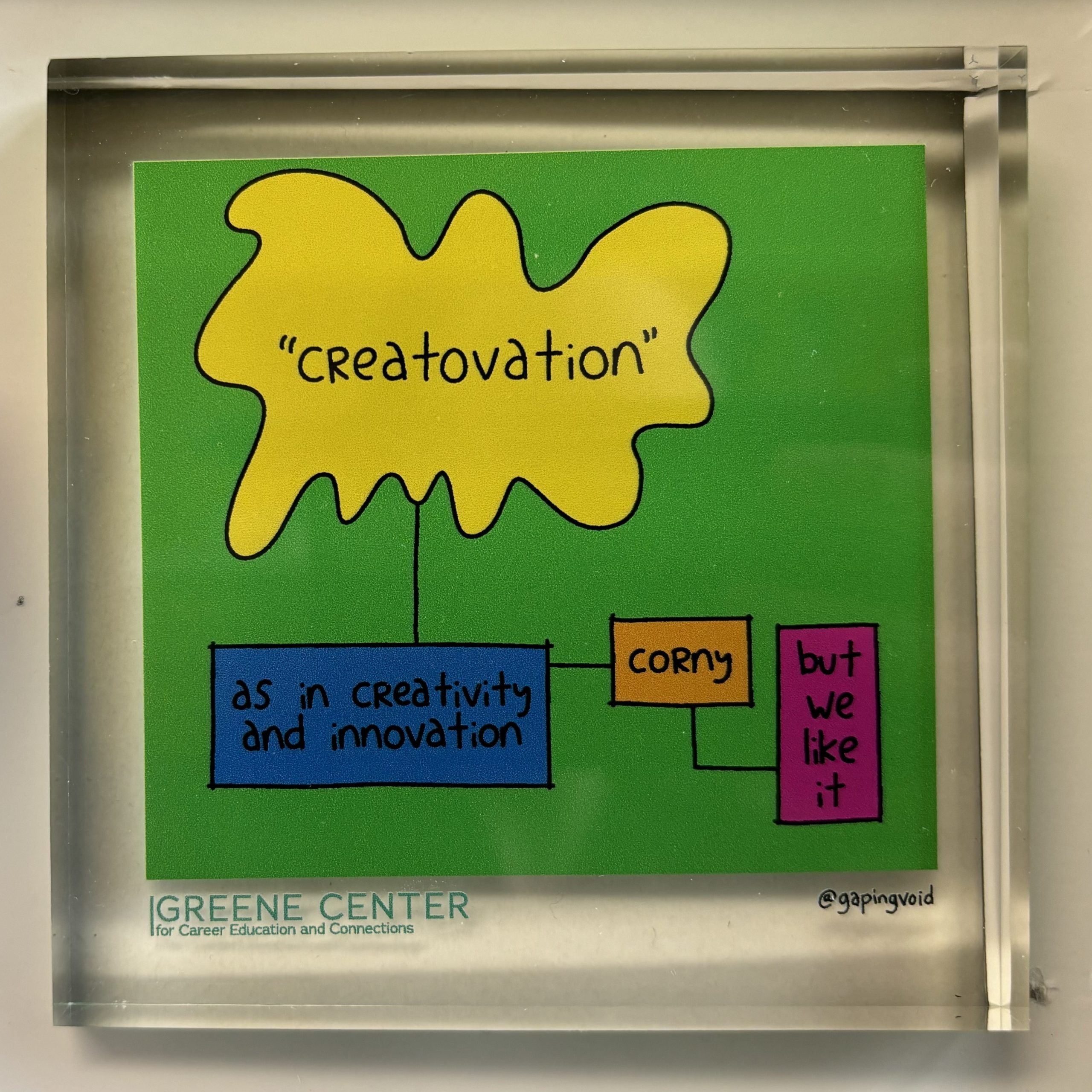
    The Roc Rainbow Rally was honored at the 2024 Gwennies in the DEI Initiatives category. The Gwennies celebrate campus partners of the Gwen M. Greene Center for Career Education and Connections at University of Rochester. We were excited to be nominated and a little shocked by the win! Thanks to Julie Moore for the nomination and all of the folks at the Greene Center for their work on and support of the Rally. We love collaborating with the Greene Center and appreciate all they do for UofR students!

    Congrats to Kate Phillips, Meaghan Moody, Lisa Wright, Vini Romualdo, Blair Tinker, Liam O’Leary, Aleem Griffiths, Dustin Paden, all of the Studio X students, our University of Rochester Libraries colleagues, campus partners, and community collaborators who made the Rally possible!

  • Studio X Annual Report 2023

    Studio X Annual Report 2023

    From Start-up to Sustainable

    In October 2022, Mary Ann Mavrinac Studio X officially opened. We celebrated the work, the people, and the vision that got us there. There is an excitement mixed with a dash of chaos and exhaustion that comes from opening a new space and program. But opening wasn’t a finish line; it was another starting point.

    In our “restart,” we’ve thought about what we learned, what needs to change, and where we want to go next. Even though we’re working to reset our aspirations, we’ve had some clear—and big—wins this year:

    • We surpassed 1,000 new Extended Reality (XR) users.
    • We added 16 high-end workstations to a first-floor classroom in the Carlson Science & Engineering Library.
    • We hired Liam O’Leary as the full-time XR Developer.
    • We celebrated Meg Moody’s promotion to Assistant Director for Studio X.

    Our quantitative data shows we’re making steady progress, but it’s time to stop thinking like a start-up. That’s not us anymore. We have to start thinking long-term. We’re shifting our focus to qualitative factors that will create a more sustainable extended reality (XR) space and program. We’ll build that by building on our strengths:

    • More programs that lower barriers to entry, such as entry-level workshops, reading groups, and guest speakers.
    • Create tiers of support rooted in the specific needs of the community we serve
    • Further cultivate a welcoming community and environment through weekly polls and taking the time to get to better know our students and their interests.
    • Empower our students to take on leadership roles that keep us moving forward.
    • Work with faculty and students across the University by helping them incorporate XR in their courses and advance their innovative transdisciplinary research.

    Read more at the Studio X Annual Report.

  • Extended Reality(XR)’s Growing Use in Higher Education

    Extended Reality(XR)’s Growing Use in Higher Education

    In April 2023, I took part in a Project Briefing session on Extended Reality’s Growing Use in Higher Education at CNI’s Spring Membership Meeting in Denver, CO. It was great to hear about the work being done in the field of XR at peer institutions and share out some of the lessons learned in our first year of having Studio X up and running.

  • Boundless Possibilities

    Boundless Possibilities

    As part of the University of Rochester’s new strategic plan, Communications interviewed members of the university community to ask them what excites them about their work at UR and what boundless means to them. When I think about the boundless possibilities of our library and our university, I think about the way we must continue to evolve, learn from our past, value each others’ expertise, and bring people together to solve the challenges that lie ahead. It isn’t easy. It’s work. But it’s also worth it.

  • Studio X Annual Report 2022

    Studio X Annual Report 2022

    How did we get here?

    When I started working on Studio X in early 2019, it was an idea with a roadmap. That idea was shaped by community needs gathered through interviews, design activities, and extensive work done by the original steering committee led by Lauren DiMonte, now associate dean of Learning, Research, and Digital Strategies. What we learned boiled down to access to:

    • Space that feels welcoming to all
    • Expertise that lowers barriers to entry
    • Technology that stays current
    • Community that fosters collaboration

    Today, the requests we receive from our community still echo the feedback from our original user research. But what does success look like? We asked stakeholders what they want to see, and they said:

    • New users in the space and events that would make all feel welcome.
    • Faculty incorporating extended reality in their teaching and research.
    • Studio X having a big impact on our students, faculty, and the broader community.

    Our mission statement was created to achieve these goals, and we hope you see them reflected in this report.

    I do need to point out that as much success as we’ve had, the past year wasn’t all rainbows and unicorns. Supply chain issues delayed our technology. And like many units across the University, we were short-staffed and had trouble filling positions and finding people with the skills we needed. Although we have assembled a team of dedicated and skilled students, we see our team as a work-in-progress. Case in point: we still don’t have the staff to fully meet faculty needs. Finally, as is true with all new spaces, we discovered physical and technical limitations, which sometimes forced us to rethink our strategies for programming and events.

    We’re proud of what we have accomplished in our soft-launch year, and we look forward to continuing to build the program, space, and community at Studio X.

    Read more about our first year at the Studio X Annual Report.

  • Future of Learning Symposium, Purdue University

    Future of Learning Symposium, Purdue University

    In spring 2022, I was invited to speak at Purdue University as part of a Future of Learning Symposium they were hosting in support of the classroom master planning initiative. The session I spoke at was focused on “Pollinating Open Space — Libraries, Innovation Centers, and Other Spaces for Cross-Disciplinary Discovery.” I centered my talk on Studio X and creating a space for cross-disciplinary experimentation, collaboration, and community.

    Read more about the panel and watch the video.

  • CNI Digital Scholarship Planning Webinar

    CNI Digital Scholarship Planning Webinar

    As part of the Coalition for Networked Information (CNI) Digital Scholarship Planning Webinar Series, I presented on a session on Initiatives for Teaching & Learning. My talk, “Beyond Tech: A Pedagogical Approach to Incorporating Digital Projects in the Classroom,” introduced a model for faculty development workshops that focus on assignment design and interdisciplinary discussions to develop digital projects for courses that increase students’ digital literacy skills while highlighting diverse library expertise and the potential for meaningful collaboration.

  • Digital Projects and Platforms

    Digital Projects and Platforms

    The Need

    In May 2020, I was approached by Joan Saab, Vice Provost for Academic Affairs at the University of Rochester. She was tasked with thinking about ways to help faculty prepare for the fall semester in the wake of the rapid shift to online learning that took place in the midst of the COVID-19 pandemic. Faculty pivoted quickly to using Zoom and other online tools, but the results were mixed and the approaches still unfamiliar and limiting to many of our faculty. As we looked ahead to an uncertain fall semester, we knew that we needed to do more to help faculty think intentionally about the courses and how digital tools and platforms might help them increase engagement and deepen their learning experiences, even if we remained fully online.

    The Digital Scholarship Lab at River Campus Libraries supports faculty and student research through the use of digital tools and methods in order to create new knowledge and technology-rich experiential learning opportunities. In this capacity, Vice Provost Saab asked us to develop a series of faculty development workshops aimed at introducing faculty to options for furthering student engagement through digital tools and project-based assignments.

    The Workshops

    In the following three weeks, the Digital Scholarship Lab worked with colleagues across the library to design and develop six workshops. The five thematic workshops included a showcase of assignments, potential tools, and exercises designed to help faculty think about how they might incorporate similar approaches in their classes. The series culminated in a 2-day assignment design workshop where faculty developed and tested an assignment for implementation in a future course. The workshops were as follows:

    • Course Sites and Digital Publication 
    • Audiovisual Analysis 
    • Spatial Thinking and Mapping  
    • Virtual and Augmented Reality  
    • Cultural Heritage Objects and Exhibits
    • Digital Project Design and Implementation

    Each thematic workshop followed a similar format:

    • Faculty and Instructor Introductions (15 min)
    • Introduction to Thematic Topic (10 min)
    • Faculty Showcase (30 min)
    • Hands-on Exploration (30 min)
    • Break (15 min)
    • How Did They Make That? Exercise  (30 min)
    • Other Resources and Next Steps (20 min)

    The Numbers

    Over 50 faculty and graduate students registered for the workshops with over half attending multiple workshops. Half of the workshops had waitlists.

    The attendees represented 27 departments, programs, and institutes across all of the colleges: The College of Arts, Sciences, & Engineering, The Warner School of Education, Simon Business School, University of Rochester Medical Center, and Eastman School of Music.

    • American Sign Language
    • Anthropology
    • Art & Art History
    • Center for Excellence in Teaching and Learning
    • Computer Science
    • Digital Media Studies
    • Eastman School of Music, Humanities
    • Electrical and Computer Engineering
    • English
    • Film and Media Studies
    • Frederick Douglass Institute for
      African and African American Studies
    • History
    • Mathematics
    • Modern Languages and Cultures
    • Music
    • Philosophy
    • Psychiatry
    • Religion and Classics
    • Simon Business School
    • Susan B. Anthony  Institute
    • Theatre
    • URMC, Internal Medicine
    • URMC, Medical Humanities & Bioethics
    • URMC, Pediatrics
    • Visual and Cultural Studies
    • Warner School of Education
    • Writing, Speaking, and Argument Program

    The Feedback

    We received positive feedback from the series and requests for future workshops.

    • “I really appreciated the content and the way that you structured the time.”
    • “The workshops were a great opportunity to meet other colleagues and gain a new sense of community as well as learn new things.”
    • “Thank you so so so much! Really grateful for what you are doing and eager to work more with you in the fall!”
    • “These were both wonderfully helpful, as I plan for effective individual and group assignments and research projects completed in several stages across the semester.”
    • “I’m taking all the workshops being offered and so far I can definitely think of ways to incorporate all the tools I’ve learned in my upcoming courses.”
    • “I admire the role(s) the DSL has taken on as a trainer/supporter.  Nothing else like it.”

    To learn more about the workshops series, please see Matt Cook’s Tower Talk article, “Digital Summer School: A new workshop series helps instructors teach in a virtual classroom.”

    The Resources

    All of the resources that were gathered for the workshops, including videos of the faculty showcase presentations, were curated and made publicly available on the Digital Projects and Platforms website.

  • IMLS Laura Bush 21st Century Librarian Grant

    IMLS Laura Bush 21st Century Librarian Grant

    Library Consortium Receives Grant to Support Data and Digital Literacy

    by: Matthew Cook, Sr. Communications Officer for Libraries and Collections, University Communications, University of Rochester, originally posted: Digital Scholarship Lab, 10 Jul 2019.

    Ninety percent of the world’s data is only two years old, and the tools, methods, and platforms to explore and use it are continually evolving. The overwhelming pace at which information and technology are created is making digital and data literacy both a high priority and a daunting task for librarians.

    These literacies are increasingly becoming a requirement for research, education, and civic participation. And the growing demand for training in public libraries, as well as those in schools, at all levels, is often at odds with available funds.

    Librarians across central and western New York now have a champion for their challenge.

    The New York Data Carpentries Library Consortium (NYDCLC), composed of the University of Rochester, Colgate University, Cornell University, and Syracuse University, is developing plans for a much-needed support system.

    With planning grant funds from the Institute of Museum and Library Services’ Laura Bush 21st Century Librarian Program (LB21), the NYDCLC is building a scalable skill-sharing program for regional universities and public libraries.

    Emily Sherwood, director of the University of Rochester’s Digital Scholarship Lab and principal investigator for the LB21 grant, says it was important to start with a planning grant, which provides the time to build a sustainable structure and meet the needs of the consortium’s institutions and their respective regional library councils.

    “In a year, we will go after a three-year project grant,” Sherwood says. “But this planning grant will help us complete a needs assessment, run initial skill-building workshops, and complete pedagogy training for 15 instructors throughout the region. We will end the year with a public symposium to talk about what we learned and our plans moving forward.”

    The NYDCLC will work with faculty and librarians at the institutional and public levels to identify training priorities for skill-based workshops. The consortium has identified The Carpentries as a sustainable train-the-trainer model that will provide librarians with skills they need to pass their knowledge on to their patrons.

    The grant also includes funds that help librarians defray the costs associated with attending workshops. In the fall, the NYDCLC will host three Carpentries skill-building workshops across the region with 40 slots available in each.

  • Should Higher Education go Digital?

    Should Higher Education go Digital?

    In early March 2019, I was asked to participate in an episode of the University of Rochester’s QuadCast, the university’s official podcast. The conversation was about being human in a digital world and the impact of the digital on higher ed. Jim Ver Steeg of University Communications, hosted the discussion with Joan Rubin, the Dexter Perkins Professor of History and the Ani and Mark Gabrellian Director of the University of Rochester Humanities Center, Jayne Lammers, associate professor at the Warner School of Education and associate director of the Center for Learning in the Digital Age, and me. Read about the podcast, access the full transcript, or listen below.

  • Behind the Curtain: The Collaborative Core of Digital Scholarship

    Behind the Curtain: The Collaborative Core of Digital Scholarship

    In 2017, Bucknell University’s Library and Information Technology celebrates 20 years as a merged organization. In our fall edition of The Next Page, we look at ways that the merger has created opportunities for innovative work. As the head of the Digital Scholarship Program at Bucknell, I took the opportunity to reflect on the range of support and expertise offered by my colleagues across L&IT. While Digital Pedagogy & Scholarship, Research Services, and Special Collections often receive the accolades for the work being done with faculty and staff, there is a tremendous amount of unseen and unsung labor provided by people in other groups. I wanted those colleagues–and the campus–to know that our success is because of them. Our program would not have advanced without the efforts of the entire division. This article only begins to express my gratitude for their intelligence, time, expertise, and generosity.

    “Behind the Curtain: The Collaborative Core of Digital Scholarship”
    Originally published in The Next Page, Bucknell University, Fall 2017.

    If you search for articles discussing “What is digital scholarship?” you will likely find a definition that emphasizes the new modes of teaching, research, and knowledge creation afforded by digital tools and methods. But if you read on in an attempt to find out how institutions support digital scholarship or the advantages of this type of inquiry, you inevitably encounter the word collaboration. This is both a strength and a challenge of digital scholarship: the range of skills, tools, and resources needed to shepherd a project from concept through production necessitates a team effort. To do it well, with an eye toward sustainability and long-term viability of the project, deep understanding and expertise are required. Fortunately, as a merged organization, Library and Information Technology is readily able to collaborate with faculty and students on their digital scholarship projects.

    When we say that Library and IT collaborates on digital scholarship projects, we mean the entire division. Discovery and Access Services maintains our institutional repository, secures access to databases and digital resources central to the production of much of our work, and provides deep knowledge of metadata, crucial for creating discoverable and easily accessible digital scholarship projects.

    Technology Services manages the imaging on our computers and in our labs to account for specialized software needs for digital scholarship. To do this, they maintain software delivery systems to guarantee that software is readily available, compatible with multiple systems, and is customized for use at Bucknell. They are paramount when exploring new and emerging technologies and partnering on experimental programs, such as our current virtual reality pilot. They also administer and distribute a cache of devices central to the production of digital scholarship, often working with faculty and students in order to accommodate technology needs for classes and research projects.

    Systems Integration keeps all of our hosted platforms updated and running smoothly. They provide expert feedback on a range of issues central to digital scholarship projects, including hosting, access, and storage options. Frequently, they come to our rescue when a rogue plugin or user mistake locks a system. Without their knowledge and ability to quickly problem solve, we would not be able to effectively work with faculty on complex projects.

    Enterprise Systems audits project databases for stability, security, and interoperability. Often, we turn to the innovative and forward thinking Web Development team to help faculty conceptualize new ways to publish and interact with their research. Their ability to break down projects and explain the components helps us determine viability, and understand and expand our ideas of what is possible. The Business Intelligence group has partnered with faculty, staff, and students to provide training on new modes of data visualization.

    Most digital scholarship projects require substantial data transfer and bandwidth. Without the expertise and support of Networking and Telephony, we would not be able to work with and render large data sets, produce complex multimodal projects, synchronously work with faculty and students, or make our projects publicly accessible.
    Our Operations and Budgeting team reviews licensing and works with vendors to procure software and hardware necessary for our continued support of digital scholarship projects. They provide critical help in planning for and executing our workshops, events, and summer programs.

    While members of Digital Pedagogy and Scholarship, Research Services, and Special Collections/University Archives are often the primary points of contact for faculty developing research projects, we could not provide this high level of support without the commitment and range of expertise from our colleagues across Library and IT.

  • Digital Scene Books

    Digital Scene Books

    At Bucknell University, Theatre 240 students traditionally compile Director’s Books for two projects during their semester: a short scene and then a longer production. As part of Library and Information Technology’s 2015 Beginning Digital Pedagogy workshop–a workshop that I created and ran–Professor Anjalee Hutchinson designed a template for her students to create their director’s books using WordPress. The template provides instructions and rubrics for each element of the assignment. Students import the template to their WordPress site, replacing the instructions with content as they move through the assignment.

    Throughout the process, students learn the various components of directing a play. The scaffolded nature of the assignment–the smaller scene site followed by the more complex final production site–allows students to gain familiarity with the tool and components during the first iteration and then expand their design in the latter project. The digital medium provides them with the ability to incorporate a range of multi-media research and design concepts. Moving from a traditional notebook assignment to a digital one facilitates the development of digital literacy skills, a central concern for Professor Hutchinson as she thinks about skills that theatre students need to acquire to be competitive in the industry after they graduate. The digital Director’s Book also allows students the opportunity to create an artifact of their work as a director that can be readily shared beyond the classroom whether applying for MFA programs, internships, directing programs, or a job with a theatre company.

    The assignment has run three semesters, with increasing success. Now, with a cohort of theatre students who have been through the course, we have seen an increase in the quality of the sites. Part of this is due to our continue development of the instructions and rubrics and part of the success lies in the fact that current students seek out help from their colleagues who have been through the process. For me, it has been exciting to see the students develop a critical eye for website design–a skill they apply later when developing their own actor websites. As we think about the skills that students need, I think it is exciting that the theatre department has embraced the need for students to engage in public writing and digital tools.

    As an example, see the development between Carrie Molnar’s scene book for Stop Kiss and her cocktail book for A Matter of Husbands.

  • Visual Literacies: Digital Essay

    Visual Literacies: Digital Essay

    The documents for this digital essay assignment were created for a second year integrative perspectives course, UNIV200.09 “Visual Literacies in a Digital World.” The course was taught in the spring of 2016.

    Throughout this Integrative Perspectives course–taught by two faculty from different disciplines–students explored what it means to be a visually literate person in a digital age. In the second half of the semester, students created Digital Essays. The topic of the essay, “The Rest of the Story,” pushed students to think about the frequent disconnect between the curated image or online identity and the underlying influences or story that lead to the representation. In an increasingly visual culture, students often struggle to apply a critical lens to movies, television, commercials; however, they do so with ease when engaging with texts. Professors Mann and Sherwood selected the digital essay format in order to help students develop their ability to think critically about multi-modal work by understanding how image and sound impact our experience. In making choices to strengthen their written/spoken argument through the incorporation of images and sound, students begin to understand how others use such stimuli in order to impact their experiences and understanding.

    Documents:

    Student feedback and examples:

    Madison Weaver, Bucknell ’19
    “I was a little apprehensive about the project at first because I had never used iMovie, but I found the program easy to learn and create with by the end. There were some parts of the story that I already images in mind for and found easily, while other times I found myself staring at the screen trying to brainstorm representative images. I really enjoyed finding the appropriate clips and loved when the music and images lined up perfectly – I especially loved adding the cracking glass in the middle of silence when the bulb breaks.”

    Terry Hall, Bucknell ’19
    “In terms of creating this project, I really enjoyed the experience. It gave me an opportunity to try all new things that I never even thought I would be doing in a classroom. The fact that we were able to choose our stories to tell as well gave me an opportunity to make this video very personal which made the task even that more fun. I basically was able to make a video to honor my grandmother’s life.”

    Creative Commons License
    The assignment, assessment, and peer review sheets on this page are licensed under a Creative Commons Attribution-NonCommercial-ShareAlike 4.0 International License.