In spring of 2024, I testified before the Copyright Office for Library of Congress in support of a petition to expand exemptions for Text and Data Mining (Class 3a: Motion Pictures) as part of ninth triennial rulemaking proceeding under the Digital Millennium Copyright Act (DMCA). My testimony focused on research that Digital Scholarship at River Campus Libraries had been working on with Professor Joel Burges (University of Rochester) and Professor Allison Cooper (Bowdoin College) as part of a Mellon Foundation Public Knowledge Grant on the history of the close-up in film and television (https://www.library.rochester.edu/about/news/close-close-ups).
In October of 2024, the Library of Congress, following recommendations from the Copyright Office, released its ruling on the renewal and expansion of exemptions to prohibitions on circumvention of technological protection measures. For the purpose of our research, the following outcomes (highlighted in this post by the Author’s Alliance) were important:
- The exemption now allows access to a corpora for research and teaching without requirements that the research be a collaboration. This means that if I create a corpora and you, as a researcher, want to verify my data after the fact, continue my research, or as new questions of your own, you can do that.
- The recommendations clarified that “close-viewing” of media is allowed if it furthers the research and is not for the work’s expressive value. In other words, researchers can watch copyrighted materials and mark or annotate them in order to generate data to further their research. This is an important clarification and crucial for our research which relies on close viewing in order to generate data on representation.
Working with Professor Burges, Professor Cooper, the Authors Alliance, and the Samuelson Law, Technology & Public Policy Clinic at UC Berkeley on this petition and the testimony was both an impactful experience. Too often, we don’t get to see significant change as a byproduct of our research, but effectively advocating for the needs of researchers and having that result in concrete recommendations and a ruling from the Library of Congress is exactly that. I am grateful to my colleagues and the folks at the Authors Alliance, Samuelson Law Clinic, and the Mellon Foundation for the opportunity.
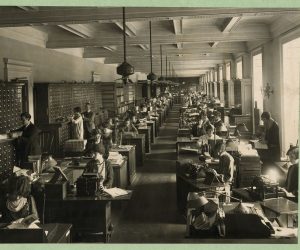
Image Credit: Copyright Office. Library of Congress. Washington D.C, ca. 1920. Photograph. https://www.loc.gov/item/2005694708/.